¶ Trading With SIM Teams
In 4040 Baseball you can trade with SIM teams just as you can with human-owned teams.
SIM teams are pretty shrewd trade partners. They each have a plan for their roster, so you won't be able to swoop in and grab a team's best player for a bunch of spare parts.
¶ GM Notes
Once you find a player you want to trade for, click the GM Notes button to the right of the player’s name (in the Propose Trade window) to see what the GM considers acceptable trade matches for that player.
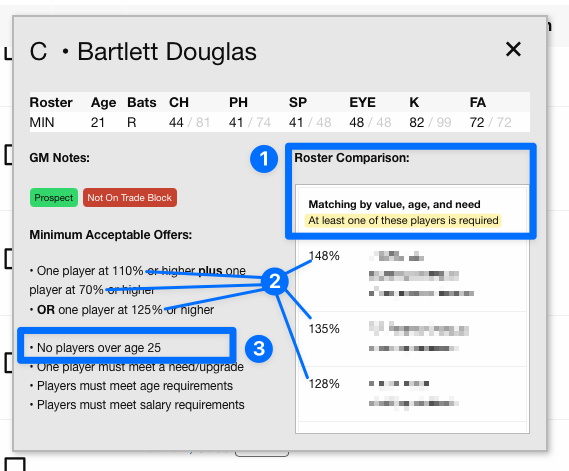
- Roster Comparison, Matching by value, age, and need: You MUST ALWAYS include at least one player from this section. The GM will not accept a trade without one of these players.
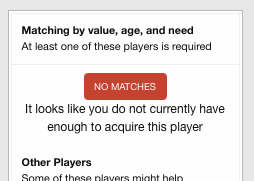
- If you see the message: "NO MATCHES" in this section, then you will not be able to trade for this player.
-
Minimum Acceptable Offer Match Values: On the left the GM tells you the minimum values that are acceptable for this player. Those values can be cross referenced against the values in the Roster Comparison window.
-
Minimum Acceptable Offer Other Requirements: Also on the left side of the pane, the GM lists any other requirements for the trade. In this example, the GM will not accept any player over age 25 in exchange for the player.
-
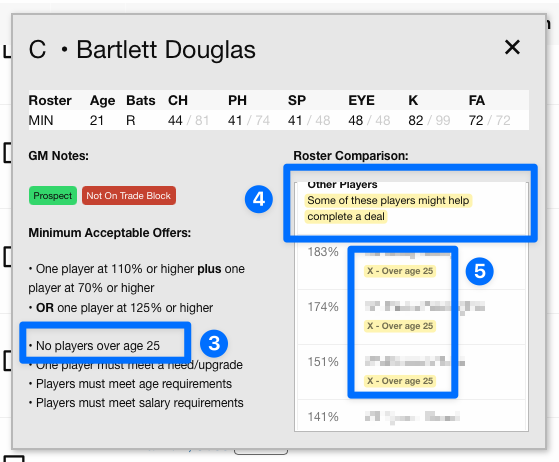
Roster Comparison, Other Players: This section of the roster comparison lists optional players who might be useful to meet the trade reqirements.
-
Roster Comparison, Unacceptable Players: Within the optional players you may see a notation under a player that begins with an "X". In this example, the first three players are rejected because they exceed the stated age limit of 25 years.
You can learn more about SIM Team Roster Modes below.
¶ Proposing A Trade To A SIM GM
To propose a trade, select players from your own roster that match the Minimum Acceptable Offer listed in the GM Notes.
You may offer or request as many as five players from each team--but the GMs requiremeents for each of their players must be met.
If the GM Is Interested In Your Proposal
If the GM is interested you can submit the trade offer as-is, by clicking the Submit As-Is button.
This will add it to the queue of trade proposals that team has received. The GM will later compare your proposal against the others, and if yours is the best, accept the trade. If another trade is superior, the GM will decline your trade offer in favor of the other.
You may also modify the proposal by clicking the Modify Proposal button.
If the GM IS Not Interested In Your Proposal
If the GM cannot accept your trade offer, they will provide feedback explaining why.
Based on that feedback, you can modify the proposal by clicking the Modify Proposal button.
You can learn more about SIM Team Feedback below.
¶ Receiving Trade Proposals
SIM teams will offer you trades for players you list on the Trade Block.
It is possible that none of your players will interest any SIM teams, and you may not get any SIM offers.
A SIM team will only make one offer per day to your team and will not duplicate offers.
More about the trade block.
¶ Roster Modes
SIM teams make their roster decisions based on the needs of their team and/or organization.
A team will state their roster plans in the Team Preferences area. You can access this from a team's page, as well as from the trade area. And this information can help you craft better trade offers.
MAJ Needs
Describes the areas of the Major League Roster a team needs to address. To create the strongest possible trade offer, include players who match with one or more MAJ Needs.
Upgrade Targets
Identifies which players on the Major League roster a team is looking to upgrade. Offering upgrades can be a great way to lower your own payroll while acquiring a viable option at the same position.
MIN Priorities
Every team is trying to maintain a minor league system full of viable players. As they acquire or promote prospects, teams develop new minor league priorities. Offering a prospect that aligns with a team's minor league priorities can help strengthen a trade offer.
Trade Block
When a team places a player on the Trade Block they are signaling that player is not currently a part of their present or future plans. Reasons for placing a player on the Trade Block can vary, but it typically comes down to a few reasons: Either the player is not going to be extended, is duplicative of another player, or the team has entered Rebuilding Mode.
You can view all players placed on the Trade Block through the Player Search page. In the trade window, players on the Trade Block are noted with a "TB" badge next to their name.
More about the player search.
¶ Standard Roster Mode
When in Standard Mode a SIM team focuses on being competitive, looking to improve their roster for the short-term, while retaining a core group of players, and improving their minor league system. A GM for a team in Standard Mode favors deals that make the team more competitive, now or in the future. They are unlikely to make big trades, preferring instead to focus on minor upgrades and improvements.
Trading with teams in standard mode is difficult unless you can match a need they've identified. Trades with these teams are best suited for minor roster adjustments.
¶ Deadline Seller
A SIM team in Deadline Seller mode has determined they won't be making a playoff push. They are looking to acquire young talent and draft picks at the trade deadline to help them in future seasons in exchange for veteran talent or players who no longer fit their plans.
Trades with Deadline Sellers are usually a good short-term deal--a great way to add some punch to your team for a season or two, without giving up too much.
¶ Deadline Buyer
When a SIM team is near the trade deadline, and has a good shot at the post-season, they will be looking to acquire veteran talent that might give their team a boost or more depth. They are willing to deal away prospects, draft picks, or players for upgrade, in exchange for impact players.
Trades with deadline buyers are a great way to land a decent return for departing players, or to offload salary.
¶ Financial Rebuild
When a SIM team begins a new season, and has a cash deficit, they switch to Financial Rebuild mode. The goal of this mode is to shed as much payroll and acquire as much cash as possible. It is not a fire sale. Instead the team is focused on flipping expensive contracts for team-friendly ones, and cash.
For each player you request from them, the SIM team insists on:
- reducing payroll by at least $3.5M;
- AND receiving at least $7M in cash
Following are some examples:
| Players Requested | Cash Sent to SIM Team | Payroll Reduction for SIM Team |
|---|---|---|
| 1 | $7M | $3.5M |
| 2 | $14M | $7M |
| 3 | $21M | $10.5M |
A team in Financial Rebuild is a great match for acquiring high-caliber players, and off-loading duplicative or lower-quality players, assuming you don't mind taking on some salary, and parting with some cash.
Important Note
A GM may accept a trade proposal that seems like a steal. But keep in mind, there may be 20+ other teams making proposals for that same player. Although the GM will let an elite player go for cheap, they will always choose the strongest offer.
¶ Rebuild
After a season with 95 or more losses, a SIM team will embark on a rebuild that should last three to four years. They will lock up any prospects or young talent they see as good fits for the rebuilt team, and then they will place everyone else on the trade block. They will be looking for young talent, prospects, and draft picks in trade returns. They are willing to let good talent go for less than it's worth, in the process freeing up roster space and saving on payroll, while adding pieces for their future.
A team in Rebuild Mode is a great opportunity to acquire top talent that can help you for years to come. But that trade market will be very competitive, and you'll need to part with draft picks and/or prospects.
¶ ...+Cash
Most of the roster modes listed above include a variation of "+Cash":
- Standard Roster Mode +Cash
- Deadline Seller +Cash
- Deadline Buyer +Cash
- Rebuild +Cash
+Cash Roster Modes operate the same as their non-+Cash modes, except that you must include cash as part of the deal. These teams are running a deficit (or are on course to do so) and are trying to avoid a Financial Rebuild.
The amount of cash included in an offer increases the value of a trade. You must still meet the core trade requirements, but your trade offer can become more valuable than someone else's, by adding enough cash to bolster the deal.
¶ Feedback
SIM teams will provide feedback when you submit trade proposals. Following are explanations of the feedback messages you could receive.
¶ Finances: Currently in a financial rebuild. Unwilling to send cash in a trade.
Explanation
The team is in Financial Rebuild mode and won't send cash in a trade.
Solution
Modify your trade proposal so as to NOT request cash in return.
¶ Finances: Currently in a financial rebuild. Unwilling to trade away draft picks.
Explanation
The team is in Financial Rebuild mode and won't send draft picks in a trade. This is because the team is focused on saving money by reducing payroll and acquiring cash. Trading draft picks does not reduce payroll.
Solution
Modify your trade proposal so as to NOT request draft picks in return.
¶ Finances: Not willing to purchase players or draft picks.
Explanation
You have made an offer that only requests cash in return. This team is not interested in purchasing players or draft picks.
Solution
Modify your trade proposal to include players and/or draft picks in return.
¶ Finances: Only willing to accept offers that include at least $5M in cash for each player requested.
Explanation
The team is in Financial Rebuild mode and requires at least $5M in cash (per player) in compensation. Your trade proposal does not include enough cash.
Solution
Modify your trade proposal to include and average of at least $5M in cash for each player you are requesting from the trade partner.
- Example: If you request two players in the trade, you must offer at least $10M in cash (2 requested players X $5M)
¶ Finances: We are not willing to spend the amount of cash you are requesting.
Explanation
You have requested more cash from the team than it is willing to exchange.
Solution
Modify your trade proposal so as to request less cash in return.
¶ Finances: We currently require cash in every trade.
Explanation
The team you are trying ot trade with requires cash in every trade.
Solution
Modify your trade proposal to include cash.
¶ Payroll: Only willing to accept offers that reduce payroll obligations by at least $5M for each player requested.
Explanation
The team is in Financial Rebuild mode and needs to reduce payroll by an average of $5M for each player traded away. Your trade proposal does not reduce payroll by that minimum average per player.
Solution
Modify your trade proposal so that the team's payroll is reduced by at least $5M per requested player.
- Example: The following would be an acceptable offer:
| Requested | Offered | Salary Reduction |
|---|---|---|
| 1B John Doe, salary: $10M | CF John Smith, salary: $3M | $7M |
| 2B James Dove, salary: $10M | SP Jorge Sole, salary: $7M | $3M |
| $10M total | ||
| $5M average |
¶ Payroll: Player contract year is too expensive: [player-name], age [player-age] season, [salary-amount]
Explanation
Each GM has their own preference for how much they are willing to pay a player based on player quality and age. In this case you offered a player who makes a higher salary than the GM is willing to pay.
Solution
Modify your trade proposal to exclude this player from the offer, OR include a subsidy to offset that player's salary.
¶ Payroll: Player contract year is overpriced: [player-name], age [player-age] season, [salary-amount]
Explanation
GMs are unwilling to pay substantial money for players below a preferred quality, and you have included a player who has a substantial salary but does not meet their standards.
Solution
Modify your trade proposal to exclude this player from the offer, OR include a subsidy to offset that player's salary.
¶ Payroll: Unwilling to take on more than $[amount] in added payroll.
Explanation
GMs are unwilling take on additional payroll beyond a certain amount depnding on their trade mode.
Solution
Modify your trade proposal to reduce the amount of payroll they would take on, either by offering different players, OR include a subsidy to offset a player's salary.
¶ Rebuilding: Player [player-position] [player-name] is beyond our max age of [max-age]. Too old to help us with a rebuild.
Explanation
The team is in Rebuilding Mode, and you have offered a player who is too old to contribute once the rebuild is complete.
Solution
Modify your trade proposal to only include younger players.
¶ Rebuilding: Unwilling to trade draft picks.
Explanation
You have requested draft picks from a team that is in Rebuilding Mode. A team in rebuilding mode will not trade away draft picks.
Solution
Modify your trade proposal so as NOT to request any draft picks.
¶ Rebuilding: You failed to request any players from our trade block.
Explanation
You have not requested trade block players from a team that is in Rebuilding Mode. A team in rebuilding mode requires that every trade proposal requests at least one player they have listed on the trade block.
Solution
Modify your trade proposal to request at least one player from the trade block.
¶ Roster: Looking for impact players, but none of the offered players qualify.
Explanation
The SIM team is looking to substantially improve their team, and you have not offered any players that help them with that goal
Solution
Modify your trade proposal to include at least one player flagged as "Impact Player".
¶ Roster: We're deadline sellers. Unwilling to trade draft picks.
Explanation
You have requested draft picks from a team that is selling off veteran talent at the deadline. They will not trade away draft picks.
Solution
Modify your trade proposal so as NOT to request any draft picks.
¶ Roster: We're deadline sellers. Unwilling to trade MAJ-ready players with more than two years of control remaining, other than those already on the trade block.
Explanation
You have requested players under long-term control from a team that is selling off veteran talent at the deadline. They will not trade away players they think can help them in the next year or two.
Solution
Modify your trade proposal so as NOT to request such players.
¶ Roster: Not currently accepting offers for [position] [player-name].
Explanation
You have tried to acquire a player the team is not willing to part with.
Solution
Modify your trade proposal to request alternate players.
¶ Roster: Only willing to trade players on the trade block.
Explanation
Your trade proposal requests players who are not on the team's trade block.
Certain teams (like those in a Financial Rebuild) are only willing to trade away players they have placed on the trade block.
Solution
Modify your trade proposal to only request players from the team's trade block. Trade block players have a "TB" badge next to their names in the trade proposal window.
¶ Roster: [ position ] [ player name ] is currently a core part of our plan. We need a suitable replacement at this position.
Explanation
The team has made plans for this player in a primary role on their roster. They cannot trade him away without being offered a comparable replacement.
Solution
Modify your trade proposal to include a decent replacement for the player in question.
¶ Roster: [ position ] [ player name ] is currently a core part of our plan. We would need a replacement that maintains our strength at this position.
Explanation
The team has made plans for this player in a primary role on their roster. They will not cannot accept a trade unless they receive a comparable replacement at this position.
Solution
Modify your trade proposal to include a comparable replacement for the position in question.
¶ Roster: [ position ] [ player name ] is not a significant upgrade for [ position ].
Explanation
You have offered an upgrade for a team's player, but the player you offered is not enough of an upgrade.
Solution
Modify your trade proposal to include an improvement for the position in question.
¶ Roster: This offer does not meet any of our needs.
Explanation
The trade proposal does not match any of the team's roster needs.
Solution
Modify your trade proposal to meet at least one of the team's roster needs.
¶ Roster: This offer would leave us with too few [ position ].
Explanation
The trade proposal would decrease the number of players available at certain position to a level that is unnacceptable for the team's major league roster. For example, you might be requesting their first baseman, and they might not have any major league ready replacements.
Solution
Modify your trade proposal to either replace the player position you are requesting, or remove the player you are requesting from the proposal.
¶ Too Much Risk: Trading with [ division / potential post-season or wildcard ] rivals is too risky.
Explanation
The GM won't normally trade with division rivals, or with teams that might stand in the way during a post-season run. The risk of bolstering your team is too high for this GM.
Solutions
- If a team is in Rebuilding Mode the GM will be more likely to break this rule, especially if you present a strong offer that meets a lot of their roster needs;
- You could also overwhelm an opposing GM with an offer too good to decline.
¶ Trade Quality: Not enough prime talent in return.
You have requested player(s) with more prime years remaining, or with higher quality prime years remaining, than you are offering in return. And in this case, the deficit is greater than the GM is willing to accept.
Solution
- Modify your proposal to include players of higher quality, or with more prime years reminaing.
¶ Trade Quality: Trade Quality: One or more players you offered are currently too injured to help the team.
You offered at least one player who is currently injured with more than fours days to heal.
Solution
- Modify your proposal to include players who are not injured, OR resubmit the offer once the player has healed.
¶ Trade Quality: One or more players you offered are not of acceptable quality.
You offered at least one player who simply isn't valuable to the GM's team. This most often occurs when you've requested a high-quality player, and then included a weaker player to pad the trade.
Solution
- Modify your proposal to include players of higher quality.
¶ Trade Quality: One or more players you offered are not of acceptable quality at their current salary.
You offered at least one player who simply isn't valuable to the GM's team at his current salary. This most often occurs when you've overpaid a player of average, or below-average, quality. While such players can be valuable as role players, they are easily acquired for low salary amounts and SIM teams are unlikely to spend miuch money on them.
Solution
- Modify your proposal to include a payroll subsidy for the player in question.
¶ Trade Quality: One or more players you offered are not viable.
Explanation
You offered at least one player who simply isn't ever going to be a viable major-leaguer. This is either a prospect who does not have the potential to be viable, or a player who has declined past the point of being viable.
- A pitcher is viable when the CO rating is at least 80, and the BP rating is at least 85
- A position player is viable when the CH rating is at least 80
Solution
Modify your trade proposal to offer only viable players.
¶ Trade Quality: We are looking to add impact players for the deadline. You must offer players who line up with our stated needs or upgrades.
Explanation
You made an offer to a team in Deadline Buyer Mode. Deadline buyers are looking to fill very specific major-league roster needs for a post-season push. Your offer doesn't match any of their stated needs, and doesn't offer an upgrade to any of their stated upgrade targets,
Solution
Modify your trade proposal to offer players who match the team's stated major-league needs or upgrades.
¶ Trade Quality & Payroll: One or more players you offered are overpaid due to their poor career numbers.
Explanation
You offerred one or more players who have such poor career numbers the SIM team cannot justify their current salary or extension amount.
Solution
Modify your trade proposal to include a subsidy for that player of at least 50% of the salary or extension (whichever is higher).
¶ Trade Value: [position] [player-name] is in final contract year. We are only accepting players with multiple years of control remaining.
Explanation
You have offered a team in Deadline Seller Mode a player who's contract expires this year. A deadline seller is preparing for next season, and will only accept players with at least two years remaining on their contract (this year, and next year)
Solution
Modify your trade proposal to include player with multipel contract years remaining.
¶ Trade Value: This trade doesn't meet our requirements as explained in the GM Notes.
Explanation
You requested one or more players, but the players you offered in exchange do not match the required compensation.
Solution
View the GM Notes for each player you requested, and make sure to include enough qualifying value for each of them.
¶ Trade Value: This trade doesn't provide us with enough benefit or improvement to the team.
Explanation
The overall effect of this trade would either weaken, or insignificantly improve the team.
Solution
Modify your trade proposal to include more valuable players.
¶ Trade Value: Too few players or draft picks being offered in return.
Explanation
Your proposal does not offer enough players or draft picks in return for the number of player you are requesting.
Solution
Modify your trade proposal to include more players and/or draft picks.
¶ Trade Value: You are not offering enough value in any single player.
Explanation
The best player you offered in this trade is not nearly as valuable to the GM as the best player you requested.
- You may have requested a player who is NOT on the trade block. A player who is not on the trade block is more valuable to a GM because the player is part of a longer-term plan.
- Or, you may have offerred a package of lesser players, hoping their collective value would outweigh the value of requested player(s). A GM is not likely to accept this deal unless one of the offered players is at least comparable to the best player being requested.
Solution
Modify your trade proposal to include a more valuable player, or only request player(s) who are on the trade block.
¶ More Information
Advanced information for those who are interested.
¶ SIM Trade Credits
When you trade with human-owned teams you earn credits toward SIM trades. These credits increase the value of your own players in the eyes of a SIM GM.
The number of credits earned in a trade with a human-owned team is determined by the quality, and quantity, of the players traded away. Teams may accrue up to 100 credits.
SIM Trade Credits are automatically applied in the GM Notes, under the Roster Comparison section, in the form of percentage points. Up to 15 credits (aka 15%) will be added to players’ comparison values for each SIM trade.
Once a SIM trade is completed, the credits used will be deducted from your team’s accrued total.
¶ How the SIM GM Decides If They Are Interested
Each GM uses a set of factors unique to themselves to determine tha value of a trade proposal.
In general terms, each GM has a vision of what they value most in players and team structure, and they only make trades which improve their team along those lines.
It is possible, and even likely, trade proposals which make sense to you will not make sense to a SIM GM.
The GM Process
Each GM reviews the proposal for aspects that immediately disqualify the proposal. Some examples include:
- You requested a draft pick from a team in Rebuild Mode (they're rebuilding--they won't trade away draft picks);
- You requested cash from a team in Financial Rebuild Mode (they're rebuilding their finances, so...);
- You offered the team a player who is not viable, or a player does not meet any of their roster needs;
- You get the idea...
The GM next assigns point values to players, draft picks, and cash.
For players the point value is derived from:
- the player's ratings;
- the player's age;
- how many years of prime performance remain for the player;
- if the player meets or creates a need on the team's roster;
- the Roster Mode of the GM's team.
For draft picks the point value is derived from:
- the overall pick;
- the Roster Mode of the GM's team.
For cash, the point value is derived from:
- the cash amount;
- the Roster Mode of the GM's team.
The GM then subtracts the point values being requested from the point values being offered.
The GM will accept the trade offer if:
- the proposal is not disqualified;
- AND the point value remains positive (above a zero)
¶ How the SIM GM Compares Proposals
Likewise, the SIM GM weights each trade offer according to their own set of factors.
As a result, a SIM team may decline your trade offer in favor of another offer that makes more sense to them, but no sense to you.
The GM Process
When comparing proposals, the GM is concerned with the trade which most improves the team, which is reflected by the highest positive point value outlined in the previous section.
- The GM will sort the trade proposals from most-valued to least-valued;
- The top-valued proposal will be accepted, and any overlapping proposals will be declined;
- If there are still any remaining proposals, the GM will return to step 1, and repeat the process until all proposals have been accepted or declined.