¶ Pitcher Usage
General Spirit: Relievers are not infinitely available.
Overuse of pitchers will lead to declined performance and (for human-owned teams) severe injury.
¶ Exemptions for SIM-Owned Teams
SIM-owned teams are exempt from the injury penalty of over-use. However, they will experience the declined performance.
The reason for this is SIM-owned teams are being stewarded for human ownership. The more serious injuries on a team, the less appealing it is for a new owner.
¶ Pitcher Endurance (EN)
Relief pitchers are identified by lower ENdurance ratings than starting pitchers. Typically, an EN rating below 73 denotes a pitcher who is considered a reliever.
¶ Innings-Pitched Limitations
The number of innings a pitcher can pitch over the course of a full season is dictated by his EN rating.
At the top of the player profile page, you can view the number of innings a pitcher can safely throw over a full season (Reg Season Limit), how many innings are safe at the current point in the season (Safe To-Date), and the total innings thrown to-date (Innings Thrown).
As the season progresses, the number of Safe To-Date innings will climb, as will the number of Innings Thrown.
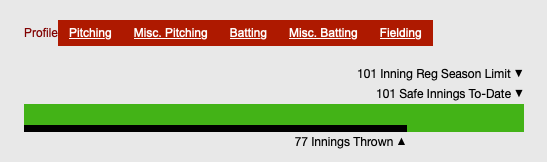
Note: The image above was taken at the end of a season.
¶ Explanation:
- Innings Thrown: The number of innings this player has pitched so far this season;
- Safe Innings To-Date: The maximum number of innings this player can safely throw at the current point in the season;
- Reg Season Limit: The maximum mumber of innings this player can throw over the course of the regular season.
¶ A Simple Rule
To keep a reliever safe from over-use, keep his Innings Thrown lower than his Safe Innings To-Date. Follow this simple rule you will never experience over-use.
One easy way to accomplish this is to enable the Balance Bullpen Use setting in your Team Settings area. Learn more about Balancing Bullpen Use
¶ Usage Warnings
There are two types of usage warnings.
¶ High-Usage Warnings
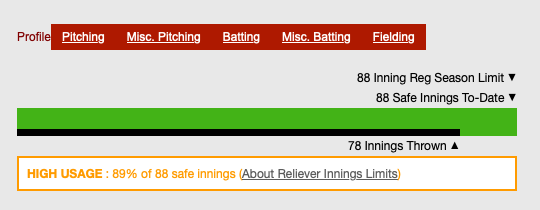
When you see a High-Usage warning it means the pitcher has thrown more than 85% of his Safe Innings To-Date limit. This DOES NOT mean he will be over-used, but because we run five games per cycle, he could wind up over-used.
The best course of action is to dial back his usage until he is no longer showing a warning.
¶ Overused Warnings
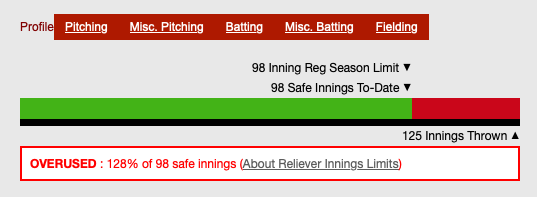
When you see an Overused warning, it means your pitcher HAS EXCEEDED his Safe Innings To-Date limit. This means his performance is now degrading, and his risk of a serious injury is high.
-
If the Innings Thrown has not yet exceeded the Reg Season Limit, the best course of action is to send the player to the minors until the alert is no longer displaying.
-
If, however, the Innings Thrown has exceeded the Reg Season Limit, the player is essentially unusable until next season (unless you enjoy terrible performance and even more terrible injuries). Shelve him in the minors for the rest of the season.
¶ A Warning About Deadline Trades for Relievers
Deadline deals to bolster your bullpen for a stretch run and post-season is a great strategy. However, always review a reliever's current usage to ensure you aren't about to trade for a guy who is headed for declining performance and/or injury.